

For decades, ventilation design has been anchored in prescriptive outdoor air requirements. By calculating ventilation rates based on occupancy, floor area, and space type, engineers have relied on a proven, code-compliant framework for delivering acceptable indoor air quality.
That approach continues to serve the industry well.
But today’s buildings present new challenges. Occupancy patterns shift throughout the day. Indoor contaminants vary by space and activity. Owners are looking for ways to improve indoor air quality while managing energy consumption and minimizing construction costs.
As buildings become smarter, many engineers are asking a different question:
Can ventilation be designed around actual indoor air quality rather than prescribed airflow alone?
That’s the idea behind the Indoor Air Quality Procedure (IAQP).
While IAQP has been part of ASHRAE Standard 62.1 for years, widespread adoption has been limited. Not because the methodology lacked value, but because implementing it often required additional, complex analysis, documentation, and engineering effort.
Today, that is beginning to change.
Advances in monitoring, filtration, localized air cleaning, connected controls, and digital design tools are transforming IAQP from a complex alternative into a practical design option for more projects.
From Prescriptive to Performance-Based
The Ventilation Rate Procedure (VRP) establishes outdoor airflow rates based on occupancy and building type. It provides a straightforward path to compliance and remains the most common ventilation design approach.
IAQP offers a different path.
Rather than focusing solely on prescribed outdoor airflow, IAQP allows engineers to evaluate contaminants of concern and use a combination of ventilation, filtration, and air cleaning strategies to achieve acceptable indoor air quality.
Evaluating both approaches side by side gives engineers a clearer picture of how different ventilation strategies affect system design, energy consumption, and project costs.
When applied appropriately, this performance-based approach can create opportunities to:
- Optimize ventilation strategies
- Improve contaminant removal
- Reduce the energy required to condition outdoor air
- Right-size HVAC equipment on applicable projects
- Better align system performance with how buildings are actually used
The concept itself isn’t new.
What’s changing is the toolkit available to support it.
The IAQP Toolkit That Works
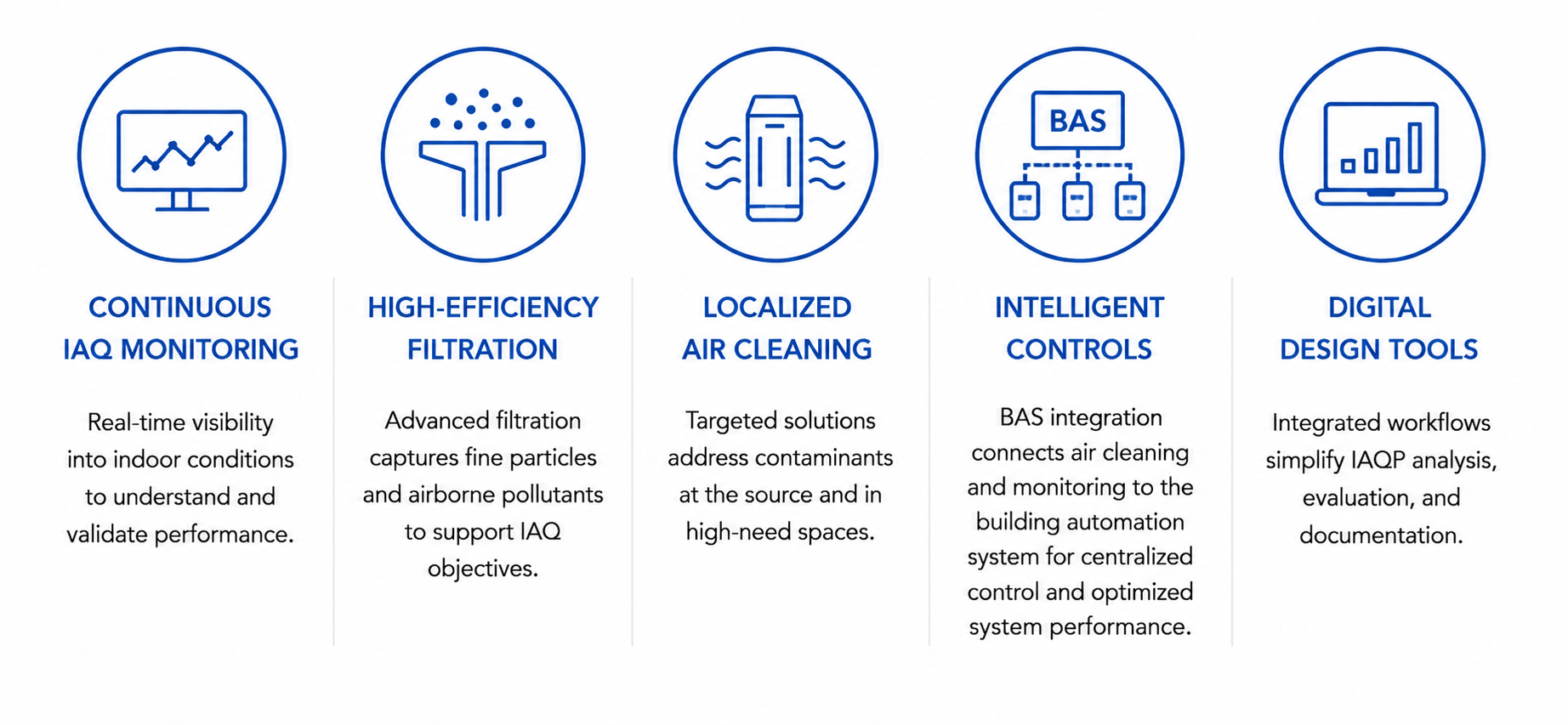
One of the biggest reasons IAQP is becoming more practical is the evolution of technologies that simplify both design and long-term operation.
Continuous IAQ Monitoring
Performance-based design begins with understanding what’s happening inside the building.
Modern IAQ monitoring provides real-time visibility into particulate matter, carbon dioxide, volatile organic compounds (TVOCs), temperature, and humidity. Rather than relying solely on assumptions, engineers and facility teams can validate building performance with measurable data throughout the life of the building.
High-Efficiency Filtration
Advancements in filtration technology have expanded the engineer’s ability to address contaminants directly.
High-efficiency filters can capture fine particulate matter, including smoke, dust, allergens, and other airborne particles that influence indoor air quality. Combined with appropriate ventilation, filtration becomes another tool for achieving performance objectives under IAQP.
Localized Air Cleaning
Not every space within a building has the same air quality challenges.
Conference rooms, classrooms, healthcare spaces, fitness areas, and collaborative environments often generate different contaminant loads throughout the day. Localized air cleaning allows engineers to target those spaces directly rather than treating the entire building identically.
This targeted approach can support IAQP strategies while providing greater design flexibility.
Intelligent Controls
Connected building technologies are also changing how IAQ strategies perform after occupancy.
Monitoring systems, air cleaning devices, and building controls can now work together to respond automatically as indoor conditions change. Rather than operating as isolated components, these systems become part of a coordinated indoor air quality strategy that can adapt over time.
Digital Design Tools
Perhaps the most significant advancement isn’t a piece of equipment at all—it’s the design workflow.
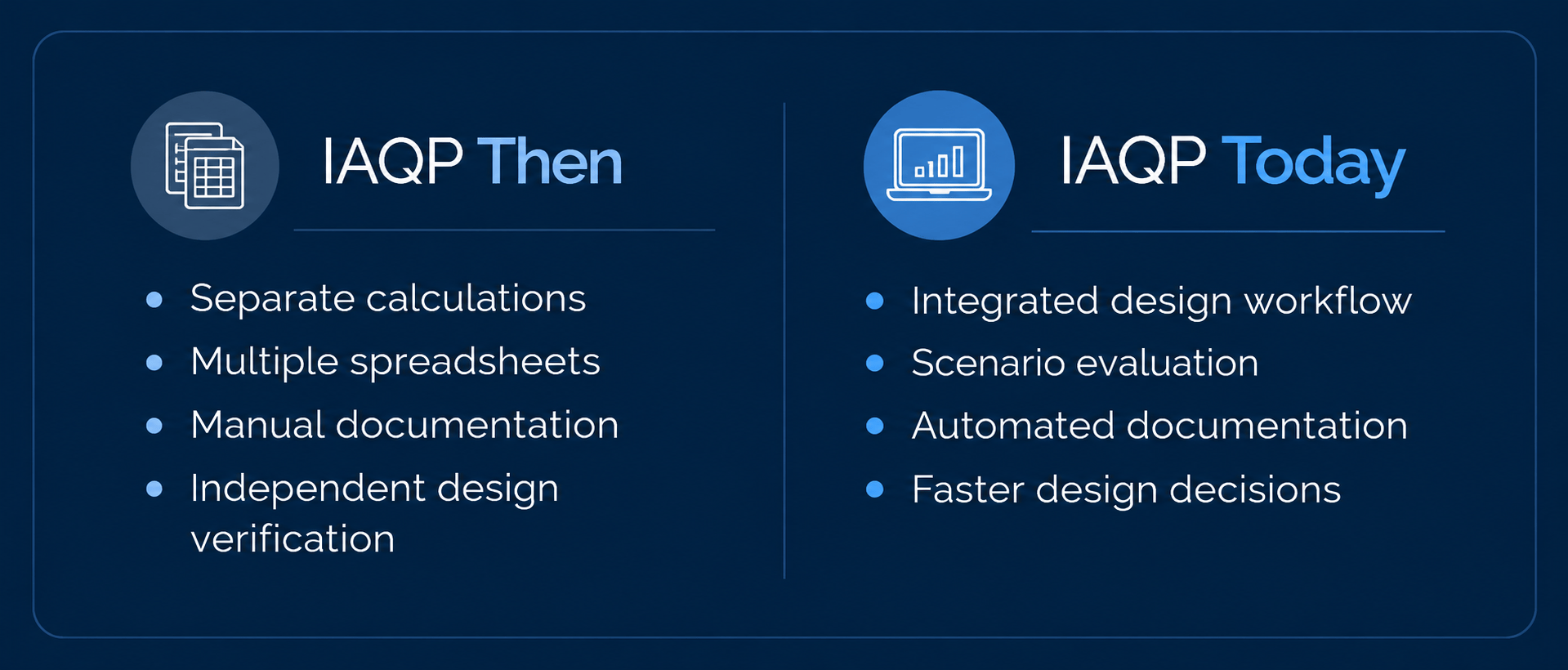
Historically, one of the biggest barriers to IAQP adoption was the additional engineering effort required to perform calculations, evaluate scenarios, and document compliance.
Today, cloud-based HVAC engineering platforms are making that process simpler and faster, streamlining the calculations, scenario evaluations, and documentation that once required significant engineering time and effort.
Through Fellowes’ partnership with HVAKR, engineers can now evaluate IAQP alongside traditional ventilation approaches within a single HVAC design workflow. By integrating load calculations, zoning, ventilation analysis, energy and ROI evaluations, and project documentation, the platform allows engineers to explore design alternatives and understand their impact on system sizing, energy consumption, and project costs. What once required separate, time-intensive processes can now be evaluated in minutes.
While digital tools don’t replace engineering judgment, they give engineers more time to focus on design decisions rather than the mechanics of evaluating them.
The Modern IAQP Tools
Putting the Tools to Work
None of these technologies work in isolation.
Monitoring provides visibility into indoor conditions. Filtration and localized air cleaning address contaminants of concern. Connected controls help optimize integrated HVAC and air cleaning system performance. Digital design platforms simplify analysis and documentation.
Together, they create an engineering toolkit that makes performance-based ventilation more accessible than it has ever been before.
For engineers, that means spending less time managing calculations and documentation and more time evaluating strategies that balance indoor air quality, energy performance, and building design objectives.
That economic connection can also help protect IAQ strategies from being value-engineered out of a project. By demonstrating potential savings through reduced outdoor air loads, right-sized HVAC equipment, and lower operating costs, engineers can make a stronger business case for maintaining IAQ investments. Rather than being viewed as an added expense, these strategies become part of an optimized building design that delivers measurable value.
Designing with Greater Confidence
IAQP isn’t a new concept.
What’s new is the technology supporting it.
With modern monitoring, air cleaning, filtration, and connected controls supporting system performance, digital engineering platforms are helping bring IAQP into the everyday engineering workflow. Engineers can evaluate alternatives, quantify potential energy and cost savings, and develop project-ready documentation with greater speed and confidence.
For projects seeking greater flexibility, measurable indoor air quality, opportunities to optimize system performance, and a pathway to reduce both first-cost and operating-cost impacts, engineers have more resources available than ever before
The future of ventilation design isn’t about replacing traditional approaches. It’s about expanding the engineer’s toolkit.
And today, that toolkit is making IAQP more practical than ever.
The Workflow Has Changed
Continue Exploring IAQP
The tools to make IAQP practical are here. Now it’s about putting them to work.
Explore how HVAKR’s cloud-based HVAC engineering platform brings IAQP directly into the design workflow, helping engineers evaluate ventilation strategies, quantify energy and cost implications, and move from analysis to project-ready documentation faster.
See how Fellowes Array IAQP-Ready solutions complement that workflow with validated filtration and air cleaning performance to support those designs in real-world applications.
Together, they help bridge the gap between what’s possible and what’s achievable.


0 Comments