

As awareness around indoor air quality (IAQ) continues to grow, so does the importance of achieving certifications that guarantee healthier and more sustainable building environments. Whether you’re striving for WELL, LEED, or Fitwel certification, these benchmarks provide measurable proof that your building is prioritizing health, wellness, and sustainability.
Why Indoor Air Quality Is a Consideration
The COVID-19 pandemic, combined with increasing concerns over climate change, has driven a new focus on the quality of the air we breathe, especially in indoor environments where most people spend up to 90% of their time. IAQ isn’t just about comfort anymore; it’s directly tied to health and productivity.
Studies from the Harvard T.H. Chan School of Public Health found that better-ventilated spaces lead to significantly higher cognitive function and decision-making abilities. In fact, a rise in VOC concentration by just 500 ug/m3 can lead to a 13% decrease in cognitive function, whereas a 400 ppm rise in CO2 correlates with a 21% decrease. Cognitive function impacts our key decision-making abilities, our productivity, and our mood. It is no overstatement that improving air quality drives a positive impact on the holistic health of building occupants.
Survey data further supports this: 90% of respondents in Fellowes’ 2024 Indoor Air Quality survey agreed that clean indoor air is essential for performing their best work. Employees are increasingly aware of the connection between air quality and productivity. As a result, providing clean indoor air isn’t just a health investment—it’s a performance booster.

Certified healthy buildings also see financial benefits, such as up to 7.7% higher rents.1 These financial returns, combined with the clear health and wellness advantages, make IAQ strategies an essential part of any modern building’s planning.
One may not expect that buildings in the United States play a significant role in energy consumption and greenhouse gas emissions, accounting for nearly half of the nation’s total. Recognizing this impact, an increasing number of building owners and operators are turning to green building certification programs to evaluate and enhance the environmental performance of both new construction projects and existing structures.
How Building Certifications Build Confidence in Air Quality
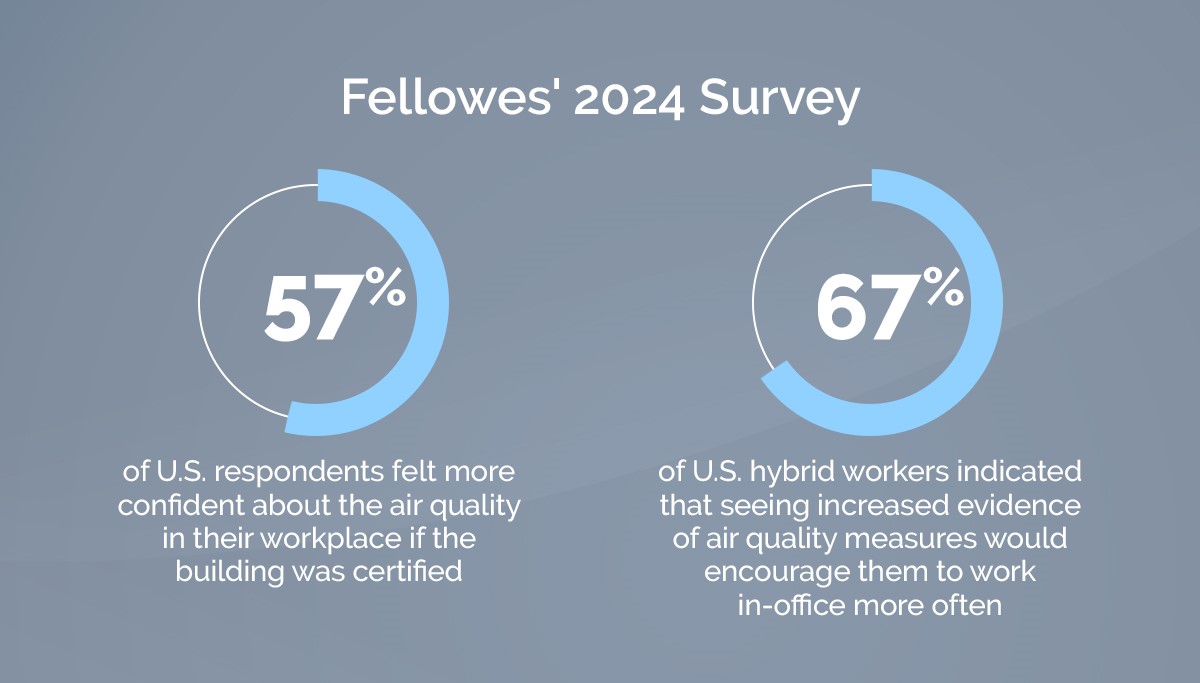
Achieving certifications like WELL, LEED, or Fitwel isn’t just about meeting a standard—it’s about fostering confidence in your building’s air quality. Fellowes’ 2024 survey found that 57% of U.S. respondents felt more confident about the air quality in their workplace if the building was certified. For hybrid workers, this confidence is even more pronounced: 67% of U.S. hybrid workers indicated that seeing increased evidence of air quality measures—such as air purification units or access to real-time IAQ data—would encourage them to work in-office more often.
With the Fellowes Array system, building owners can demonstrate their commitment to occupant health and well-being while simultaneously enhancing the value of their property. Array’s ability to monitor, purify, and display real-time air quality metrics helps meet certification requirements and gives occupants confidence in the air they breathe.
Helping to Support Building Certification Navigating the complex world of building certifications can be daunting. Requirements often differ from one certification to the next, making it difficult to know where to start. Fellowes understands these challenges and we have designed our solutions with them in mind. Our Array system offers a streamlined solution for building owners and managers who need to meet multiple certification requirements. The system’s real-time IAQ monitoring and technologically advanced purification capabilities make it easier to demonstrate compliance with these certifications, all while ensuring that occupants are breathing clean, healthy air.

1. LEED Certification
LEED is the world’s most widely used green building rating system, emphasizing sustainability and energy efficiency in addition to IAQ. LEED v5 requirements highlights the following areas of focus for certification:
- Continuous Indoor Air Monitoring: LEED rewards buildings that actively track IAQ metrics like PM2.5, TVOCs, and CO2.
- Filtration Standards: H13 True HEPA filters, which are twice as effective as MERV 13 filters, capture 99.95% of particles as small as 0.1 microns. This level of filtration meets the LEED standards for both outdoor and recirculated air.
- Response to Episodic Outdoor Conditions: Technological advancements mean that sense and react technology can support your air filtration system in adjusting to varying environmental factors, making them more efficient and responsive to fluctuations.
Utilizing Array, buildings can earn up to 12 out of the total 13 points needed for LEED v5 certification, driving significant progress towards gaining certification from one of the most well-known and established healthy building certifications globally.

2. WELL Certification
WELL focuses on human health and wellness more widely and includes a robust IAQ requirement. The WELL Building Standard poses some of the most rigorous requirements, covering essential factors like ventilation, air quality, and filtration.
WELL IAQ requirements highlight the following areas of focus for meeting certification:
- Enhanced Thresholds for Particulate Matter: IAQ solutions must monitor a wide range of particulate levels (from PM1.0 – PM10) and displays them in real-time, ensuring your building stays within WELL’s guidelines.
- Responsive Technology: IAQ solutions should utilize technology that senses and tracks multiple IAQ factors in real-time, providing instant feedback on air quality from CO2 levels to Volatile Organic Compounds such as wildfire smoke. EnviroSmart+™ Technology, incorporated into Fellowes’ Array system, continuously monitors the environment for changes in occupancy density and conditions of the space and automatically adjusts units to ramp up or down as needed.
- Better Air Turnover: Array delivers 3-5 incremental air changes per hour (eACH), which supports achieving the CDC-recommended 5 eACH and ASHRAE 241 standards.
- Air Quality Awareness: Utilizing IAQ solutions with informative displays, such as the Array Lookout display and Community Dashboard, gives occupants visibility into the air they’re breathing, fostering trust and transparency while delivering the data you need to track against certification requirements.
In total, Fellowes Array can contribute to five out of the 18 WELL Air Concept points, helping to support the IAQ portion of WELL certification.

3. Fitwel Certification
Fitwel focuses on creating healthy spaces in a more accessible, cost-effective way than WELL or LEED. It also emphasizes indoor air quality measures such as proper ventilation and filtration.
- Filtration and Monitoring: Robust filtration and monitoring capabilities are critical in improving IAQ. Array’s full IAQ sensor suite monitors PM levels, TVOCs, CO2, and more, providing real-time data through the system’s Viewpoint dashboard.
- Air Purification Systems: Filtration systems should utilize advanced filters and sanitation components to ensure air is clean and free from pathogens, allergens, bacteria, and allergens. The Array system uses UV-C disinfection and H13 True HEPA filters to capture 99.95% of airborne particles and pathogens.
- Modular Design: Fitwel certification values flexibility, and Array’s modular installation options (suspended, recessed, wall-mounted) allow it to be integrated into any building design, regardless of size or layout.
Fellowes Array can contribute 3.04 out of the total 5.89 points required for Fitwel certification, getting Array users most of the way there!
The Fellowes Advantage: More Than Just Air Quality
Improving IAQ offers a range of benefits beyond just meeting certification standards, it offers true well-being to building occupants.
In a world where health, productivity, and sustainability are increasingly linked, Fellowes Array provides a comprehensive solution for helping to support buildings with the highest standards of indoor air quality. Whether you’re aiming for WELL, LEED, or Fitwel certification, Fellowes supports your building’s IAQ goals, ensuring both occupants and building owners benefit from cleaner, safer air.
To learn more about how certification points are allocated, visit our Building Certifications page or contact one of our IAQ experts today.


0 Comments