

What you need to consider to safeguard your indoor air quality as wildfires become more frequent.

In today’s world, ensuring clean and healthy indoor air quality has become more crucial than ever, especially with the increasing prevalence of wildfires. Wildfire smoke poses a significant health risk, contaminating the air with harmful particles that can infiltrate indoor environments. At the same time, proper ventilation is essential for reducing indoor respiratory pathogens like COVID-19. However, this creates a unique dilemma: how can we balance the need for ventilation with the dangers of poor outdoor air quality?
The Danger in the Air
Wildfires wreak havoc not only through the devastation they cause on the ground but also through their harmful secondary effects on air quality. It is no secret that minimal exposure to wildfire smoke can be dangerous to even healthy individuals. The particulate matter (PM) from wildfire smoke is very small, typically around 0.4 microns (µm) in diameter, so the particles are more likely to deeply penetrate a person’s respiratory system. This, in turn, can cause both immediate and long-term health effects, especially for older adults, pregnant women, children, and people with preexisting respiratory and heart conditions. When exposed, immediate effects include, stinging eyes, irritated sinuses, wheezing, shortness of breath, headaches, itchy skin, and coughing. In the long term, heart attacks, strokes, lung cancer, and a decline in cognitive function have been linked to wildfire smoke. While the CDC advises staying indoors during periods of poor air quality, it’s crucial to recognize that remaining indoors without proper air filtration can pose greater health risks.
Increasing Air Exchanges
In recent decades, rising energy costs and the environmental impact of building operations have significantly influenced the approach to HVAC and overall building design. The proposed solution involved constructing buildings with improved airtightness and minimizing ventilation, thereby decreasing the energy needed for heating and cooling outside air. However, this approach resulted in unintended consequences, such as mold growth and elevated levels of Volatile Organic Compounds (VOCs) and Carbon Dioxide from occupants. This phenomenon, named “Sick Building Syndrome” by the WHO in 1983, presented a new set of challenges.
Therefore, a growing body of scientific and medical research led the EPA and ASHRAE to advocate for enhanced ventilation to incorporate outdoor air. Improved air mixing helps to effectively dilute and remove contaminants. Given the complexity of IAQ, multi-layered solutions are required to mitigate exposure and impacts. Multi-layered mitigation plans include source control, increased ventilation rates, increasing filter efficiency and adding localized air cleaners. In response to COVID-19, the ASHRAE Epidemic Task Force now recommends increasing ventilation to 5-6 Air Changes per Hour (ACH) to enhance IAQ and reduce exposure to airborne pathogens. The air change rate is the number of times the total air volume in a space is fully exchanged within an hour, bringing in fresh air and expelling stale air to reduce the amount of airborne pollutants. Currently, most indoor spaces have less than 3 ACH and may lack increased filter efficiency to effectively remove contaminants.
The Unintended Dilemma
Standard HVAC systems generally do not consider poor outdoor air quality. This becomes especially challenging as wildfire smoke increasingly blankets vast regions of the United States and Canada each year. While ventilation is crucial for minimizing indoor respiratory pathogens like COVID-19, it can be counterproductive when outdoor air quality suffers due to wildfires. Even when HVAC systems are manually set to reduce the amount of outdoor air brought in through mechanical ventilation, outdoor air still seeps into indoor spaces through cracks in the building envelope.
Simply put, the removal of indoor air causes negative air pressure that still results in the entry of dangerous wildfire pollutants.

Facilities managers are faced with temporary, imperfect workarounds according to the EPA and ASHRAE:
“Most rooftop units and larger HVAC systems are equipped with an outdoor air economizer. To save energy, the economizer uses outdoor air to replace the mechanical cooling system when temperatures allow. This can bring large amounts of smoke and particulate matter into a building during wildfire season. Finding effective workarounds to temporarily limit the economizer damper operation in response to wildfires is challenging. This [EPA and ASHRAE] framework recommends investigating what actions are needed to limit operations; this may include adding switches and control relays. Other workarounds may also be required, such as placing the outdoor air damper in manual control and setting the position to allow the minimum air required for ventilation.”
The insufficiency of this temporary, cumbersome, and often ineffective workaround becomes evident, especially with the increasing frequency and severity of climate-related pollution caused by rising wildfire threats and heatwaves. Joseph Allen, an associate professor of exposure science at the Harvard T.H. Chan School of Public Health, has been a prominent advocate for common sense solutions to avoid such workarounds.
He emphasizes that “with a respiratory pathogen, you want to lower the concentration indoors. You can do this through dilution, increasing ventilation, and through removing it from the air (filtration). With wildfire smoke, we don’t necessarily want to bring in more outdoor air, but we can use this enhanced filtration to capture those particles. So, we must think about ventilation and filtration working in tandem, and depending on the issue—in this case, wildfire smoke—you want that enhanced filtration.”
A central component to enhanced filtration is a H13 True HEPA-grade filter, which offers the most protection from a range of airborne contaminants. H13 True HEPA filtration removes 99.95% of airborne particles as small as 0.1 microns, which includes wildfire smoke’s most dangerous contaminants such as PM2.5, PAHs, and volatile organic compounds (VOCs). Because most wildfire smoke particles are at a dangerously small size, H13 True HEPA filtration ensures powerful protection even when individuals are not aware they are at risk.
Finding the Right Solution
Given the increasing frequency of wildfires, the importance of air quality preparedness cannot be overstated. IAQ systems need to address today’s challenges and anticipate tomorrow’s needs, ensuring that indoor spaces remain healthy regardless of outdoor pollution, including wildfire smoke.
An effective IAQ system should complement HVAC systems to protect against health hazards such as wildfire smoke, viruses, and other pathogens. The system should be versatile, capable of monitoring and adapting to fluctuating air quality conditions in various settings, as wildfire smoke can affect all spaces.
Key Features of an Ideal IAQ System for Remediating Wildfire Smoke
1. Powerful Localized Air Purification:
– Units that work alongside existing HVAC systems, introducing additional air changes per hour even when the HVAC system is turned off to reduce the intake of outdoor air.
2. Advanced Filtration Technology:
– H13 True HEPA filtration, which removes 99.95% of airborne particles as small as 0.1 microns, including the most dangerous contaminants found in wildfire smoke (PM2.5, PAHs, and VOCs).
3. Real-Time Monitoring:
– Advanced sensors to continuously monitor for contaminants in any space so building operators can act.
– Target conditions based on RESET standards:
- PM2.5 should be kept as low as possible, at a minimum below 11 µg/m³. Indoor levels should be lower than outdoor levels.
- Carbon dioxide (CO2) should be kept below 963 ppm.
- Temperature should be kept below 78°F/26 °C.
- Relative humidity should be kept between 35 and 50%.
- Total volatile organic compounds (TVOCs), should also be kept as low as possible, at least below 240 ppb
– Employ real-time monitoring and inter-unit communication to provide comprehensive insights into air quality changes throughout a building.
4. Adaptive and Proactive Air Quality Management:
– The system should adapt to changes in occupancy density and environmental conditions, ensuring efficient and effective air purification.
5. Easy-to-Use Dashboard:
– Provide facilities managers with the ability to respond to real-time data, notifications, trends, and precise air quality status.
– Display the current IAQ of any space to reassure occupants and promote the organization’s commitment to ensuring a safe and healthy indoor environment.
Ensuring Resilient Indoor Air Quality
As wildfire frequency and severity across vast regions of the United States and Canada continues to heighten year after year, the unfortunate outlook stands that dangerous wildfire contaminates will remain a repeat offender to good IAQ. Having an effective indoor air quality filtration and monitoring system in place has never been more pressing.
The Fellowes Array Solution
The Fellowes Array system represents a proactive and innovative approach to this growing problem, ensuring that indoor environments can maintain high air quality standards despite external challenges.
The Fellowes Array networked air quality system is a state-of-the-art approach that complements HVAC systems to protect against the health hazards of wildfire smoke, viruses, and other pathogens in all spaces. As an innovative network of localized air purification units that work alongside existing HVAC systems, Array helps solve the ventilation dilemma by supplementing HVAC systems with localized air purification units and increasing air exchanges without adding contaminated outdoor air. These units employ advanced sensors to continuously monitor the air quality in every space. They respond by filtering and purifying the air, ensuring that indoor environments remain safe and healthy, even when outdoor air quality is compromised.
Equipped with a unique and powerful fan design, Array ensures spaces benefit from an additional layer of air quality control, effectively reducing the strain on existing HVAC systems while providing additional ACH.
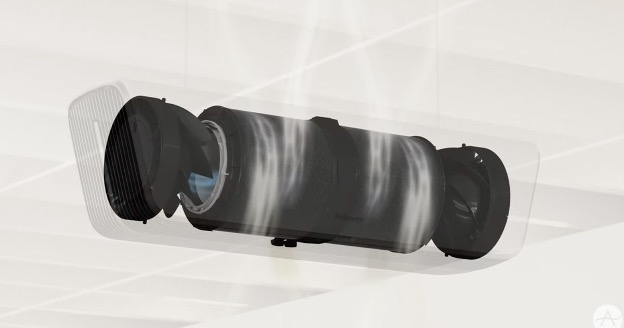
Fellowes Array proprietary mix-flow fan
At the heart of the system is the H13 True HEPA filtration technology, which removes 99.95% of airborne particles as small as 0.1 microns. This includes the most dangerous contaminants found in wildfire smoke, such as PM2.5, polycyclic aromatic hydrocarbons (PAHs), and volatile organic compounds (VOCs), ensuring powerful protection against particles too small to see but perilous to health.

Fellowes Array 3 Stage Filtration Process
Incorporating advanced sensors and a networked connection, the Array system offers real-time monitoring and inter-unit communication, enabling comprehensive insights into air quality changes throughout a building. This enables purifiers to operate at maximum efficiency, adjusting proactively to changes in occupancy density and environmental conditions thanks to the EnviroSmart+™ Technology. This innovation provides a proactive response to deteriorating air quality, reduces energy costs, and cleans air faster than stand-alone units.
The Array system’s design is perfect for retrofitting existing buildings as it does not require any ductwork connections. Its wide range of devices ensures an option for comprehensive coverage against wildfire contaminants in every space.
For real-time IAQ management, the Array system features a cloud-based dashboard, Viewpoint. This provides facilities managers with current data on the top 9 air quality factors, notifications, trends, and precise air quality status.

Additionally, the Community Dashboard is a valuable tool that informs all building occupants about the quality of the air and promotes an organization’s commitment to ensuring a safe and healthy indoor environment.
By implementing the Fellowes Array system, you can future-proof your indoor spaces against the increasing threat of wildfire smoke and other air quality challenges, ensuring a healthier and safer environment for all occupants.
Fellowes’ entire suite of air quality products has been proven effective in reducing the dangers of wildfire smoke. No matter the level of coverage or technology needed, you can protect your team’s wellness from wildfire.



0 Comments